TBT – IPV Safety Alert
Subject: IPV Safety Alert Briefing & Toolbox Talk
Incident Date:
15 September 2026
Activity:
Installation/removal of traffic management from an IPV
Incident Type:
Fall from cone well following unexpected movement of cones
What Happened
During the installation of a taper and lane closure on a dual carriageway, a three-person crew was operating from an IPV.
One operative was handling cones from the cone stack and lowering them to a second operative, who was placing them onto the carriageway.
Approximately 50 cones had been placed without incident.
While handling the next cone, the operative stumbled. The cone being handled caught the top of an adjacent stack, causing the upper section of the stack to move unexpectedly.
The moving cones made contact with the second operative’s back.
The combined weight of a stack of 1-metre cones was sufficient to knock the operative off balance. Because the operative was not expecting the contact and had no opportunity to brace himself, he fell over the side of the cone well and onto the carriageway.
The IPV was immediately stopped.
The operative sustained grazes to his hands, arms and legs and bruising and significant swelling to his ankle. He was taken to hospital as a precaution and underwent several X-rays.
Fortunately, no fractures were identified.
The Importance of this message
This incident demonstrates how quickly a routine cone-laying operation can change.
Cones are relatively light individually, but a nested stack of several 1-metre cones has considerable combined weight and momentum.
An unexpected movement of a stack can therefore create enough force to knock an operative off balance.
The risk is increased when working from a cone well because operatives are working in a restricted space, close to stacked equipment, on a moving vehicle and close to an open edge.
In this incident, the operative who fell had no warning that the cones were moving towards him and therefore had no opportunity to prepare or steady himself.
Key Learning Points
All crews undertaking cone laying or collection from an IPV must consider the following:
- Maintain a stable working position. Operatives handling cones must ensure that they have secure footing and a stable stance before lifting, moving or transferring a cone.
- One controlled movement at a time. Do not rush the transfer of cones. Ensure each cone is under control before starting the next movement.
- Be aware of adjacent cone stacks. When removing cones from or working alongside a stack, consider what could happen if the stack were to fall or topple.
- Do not rely on the apparent lightness of individual cones. A nested group of cones can have significant combined weight and can easily knock someone off balance.
- Keep clear of the line of movement. Wherever the design and approved method of operation allows, operatives should avoid positioning themselves directly in the potential path of a cone or cone stack.
- Communication is essential. The operative receiving/placing the cone should be aware that a cone is being transferred before it is moved into their working area.
- Stop if control is lost. If an operative stumbles, loses their footing, loses control of a cone, or notices movement in a stack, the operation should stop immediately rather than attempting to recover the cone while the vehicle continues moving.
- Driver communication must be immediate and unambiguous. All crew members must know the agreed command for an emergency stop. A clear call of “STOP” must result in the driver stopping the vehicle as soon as it is safe to do so.
- Never prioritise speed over control. Cone laying is repetitive and crews can naturally develop a rhythm. That rhythm must not result in movements becoming rushed or automatic.
Key Safety Requirements
This incident highlights the potential consequences of losing balance or control whilst working from the rear of an IPV.
The following requirements must be followed whenever undertaking cone laying or collection activities.
1. Restraint Bars
Restraint bars are an important safety control and must be correctly positioned and secured before cone laying or collection begins.
Safe TM Services operates a number of different IPV designs and, as a result, the exact design, mounting and adjustment of restraint bars may vary between vehicles. However, the principle remains the same: restraint bars must provide an effective physical barrier between operatives working in the cone well and the exposed edge of the vehicle.
Before moving off, operatives must:
- Check that all required restraint bars are present.
- Check that they are correctly fitted and secured.
- Ensure that the bars are being used in accordance with the vehicle’s intended operating configuration.
- Ensure the top restraint bar is positioned at approximately waist height for the operatives carrying out the activity.
- Where restraint bars are height adjustable, adjust the top bar to the appropriate height before deployment begins.
- Never remove a restraint bar simply to make cone handling quicker or easier.
Do not commence the activity if the required restraint bars are missing, damaged, incorrectly positioned or cannot be securely fitted.
Typical Restraint Bar Arrangement
The photographs below show an example of the restraint-bar arrangement fitted to one of our IPVs.

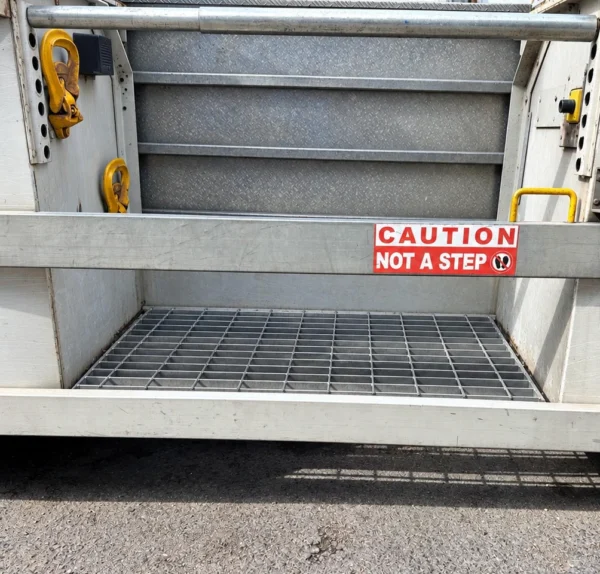
Individual vehicles may differ in design; however, operatives should expect a similar level of protection, with the upper restraint bar positioned at approximately waist height whilst working within the cone well.
IMPORTANT: Operatives must familiarise themselves with the restraint-bar arrangement of the specific IPV being used. If unsure of the correct configuration or adjustment, do not commence work until guidance has been obtained.
Familiarisation with IPV & Cone Well Design
IPVs may have different cone well designs and methods of access. All operatives must be familiar with the correct and safe method of access and egress for the specific cone well design being used.
This familiarisation will be carried out in-house and will form part of all relevant SOS briefings, ensuring that operatives understand the correct method of access and egress, positioning and use of restraint bars, location of the Emergency Stop where fitted, and the safe working positions within the cone well.
Operatives must not work from a cone well where they are unfamiliar with its design, access arrangements or safety features.
2. Clear Working Area
There must be sufficient clear space to safely perform the activity.
Before starting work, inspect the bed and cone-well area of the IPV.
The working area must be kept clear of unnecessary:
- Equipment
- Tools
- Signs
- Frames
- Straps
- Debris
- Loose materials
- Personal belongings
- Any other items that could restrict movement or create a trip or snagging hazard
Equipment required for the works must be appropriately stored and secured so that it does not interfere with the operatives’ working area.
Particular attention must be given to the areas where operatives need to stand, turn, move and handle cones.
Operatives must have sufficient room to establish a secure footing and safely handle cones without having to step around, over or between other equipment.
If there is insufficient clear working space, do not begin cone laying or collection until the area has been made safe.
3. Emergency Stop Button
All Safe TM Services IPVs, with the exception of LYK, are fitted with an Emergency Stop button within the cone well.
Before commencing work, all operatives working in the cone well must:
- Identify the location of the Emergency Stop.
- Ensure it is accessible and not obstructed by cones or equipment.
- Understand when and how it should be used.
- Ensure nothing has been positioned in a way that would prevent rapid access to it.
If an operative:
- Loses their footing or balance;
- Falls or is at risk of falling;
- Loses control of a cone or stack;
- Sees cones or equipment moving unexpectedly;
- Becomes trapped or caught;
- Sees another operative in immediate danger; or
- Believes that continuing movement of the vehicle presents an immediate risk,
ACTIVATE THE EMERGENCY STOP.
Do not attempt to recover a falling cone, unstable stack or piece of equipment where doing so could put yourself or another operative at greater risk.
For LYK, which does not have an Emergency Stop within the cone well, the crew must ensure that the agreed method of immediately communicating with the driver is understood by everyone before the operation begins.
4. Weather & Environmental Conditions
Weather conditions can significantly increase the risks associated with cone laying and collection and must be considered before starting and throughout the operation.
Wet or Icy Conditions
When wet, icy or contaminated with road dirt, cones can become significantly more difficult to grip and control. There is an increased risk of a cone slipping from an operative’s hands during lifting, passing or collection.
Wet or icy conditions can also make the bed and cone well of the IPV slippery, increasing the risk of an operative losing their footing whilst handling cones.
In wet, icy or otherwise slippery conditions:
- Take additional care when gripping, lifting and passing cones.
- Ensure you have a secure grip before transferring a cone to another operative.
- Maintain secure footing and a stable working position before attempting to lift or receive a cone.
- Be aware that wet cones may slip unexpectedly during transfer.
- Keep the IPV bed and cone well as clear as possible of standing water, ice, mud and other contamination.
- Do not rush the activity – reduce the pace of cone handling where conditions require it.
- Ensure gloves and other PPE remain suitable for maintaining an effective grip.
- Continually reassess conditions during the operation.
Other Adverse Conditions
Consider other environmental factors including:
- High winds – particularly when handling 1-metre cones, signs or other equipment that may catch the wind.
- Heavy rain – reduced visibility as well as reduced grip and slippery working surfaces.
- Ice/frost – increased risk of slips and loss of control.
- Poor visibility/darkness – reduced ability to see the working area, cone stacks, obstructions and other operatives.
If weather or environmental conditions deteriorate to the point where cones cannot be safely controlled, operatives cannot maintain secure footing, or the activity cannot otherwise be carried out safely, STOP and reassess the operation before continuing.
Remember
Conditions change – your method of working may need to change with them.
A method that is safe in dry, calm conditions may require additional care or may no longer be appropriate when surfaces, equipment or PPE become wet, icy or slippery.
Familiarisation with IPV & Cone Well Design
IPVs may have different cone well designs and methods of access. All operatives must be familiar with the correct and safe method of access and egress for the specific cone well design being used.
This familiarisation will be carried out in-house and will form part of all relevant SOS briefings, ensuring that all operatives understand:
- The correct method of access and egress.
- The positioning and correct use of restraint/fall-arrest bars.
- The location and operation of the Emergency Stop, where fitted.
- The safe working positions within the cone well.
- Any specific hazards or differences associated with the particular well design.
Operatives must not work from a cone well where they are unfamiliar with its design, access arrangements or safety features. If unsure, STOP and seek guidance from a competent person before commencing the activity.
Safe method of working
Before starting
The crew must carry out a brief check of the working area before cone laying or collection begins:
- RESTRAINTS – Are all required restraint bars fitted and secure?
- SPACE – Is the bed/cone well clear with sufficient room to work safely?
- STACKS – Are cones stable and positioned so they can be handled safely?
- CONDITIONS – Are the weather and working conditions suitable for safe footing, grip and controlled handling of cones?
- E-STOP – Does everyone know where the Emergency Stop is and can it be reached immediately?
- COMMUNICATION – Does everyone understand their role and how to tell the driver to stop?
If the answer to any of these is NO, rectify the issue before starting.
During Cone Laying / Collection
Cone handler
The operative handling cones should:
- Maintain secure footing and a stable working position.
- Take control of one cone at a time.
- Ensure the cone being handled clears adjacent stacks and equipment.
- Avoid pulling or lifting a cone in a way that could destabilise the remaining stack.
- Be aware of the position of the other operative before transferring the cone.
- Transfer cones in a controlled manner.
- Stop immediately if footing or control is lost.
Cone placer / collector
The second operative should:
- Maintain a secure and stable working position, behind the correctly positioned restraint bar.
- Remain aware of the cone handler and cone stacks behind/around them.
- Avoid positioning themselves unnecessarily in the potential path of an unstable stack.
- Use the restraint arrangements provided.
- Be prepared to stop the operation if they feel unsafe.
Driver
The driver must:
- Maintain an appropriate and controlled vehicle movement for the operation.
- Remain alert to instructions from the operatives working at the rear.
- Respond immediately to an instruction to stop.
- Not recommence movement until confirmation has been received that it is safe to continue.
If something goes wrong
If you stumble, lose your footing, lose control of a cone, notice a stack moving, or see another operative in danger:
DO NOT TRY TO SAVE THE CONES.
Cones and equipment can be replaced.
Your priority is to protect yourself and the people working around you.
Use the Emergency Stop where required and available.
The activity must not recommence until:
- The vehicle is safe.
- All operatives are accounted for and uninjured or appropriately cared for.
- Cone stacks are stable.
- The working area is clear.
- Restraint bars are correctly positioned.
- The cause of the incident or interruption has been identified and addressed.
Final takeaway
Cone laying and collection is a routine activity, but it takes place on a moving vehicle, in a restricted working area and close to the edge of the vehicle.
A small loss of footing, an unstable stack or an unexpected movement can very quickly result in a serious incident.
Before you start, remember:
RESTRAINTS – SPACE – STACKS – CONDITIONS – E-STOP – COMMUNICATION:
- Keep the working area clear.
- Use the restraint bars provided.
- Know where your Emergency Stop is.
- Maintain a stable working position.
- If something goes wrong – STOP THE OPERATION.
Read everything? Complete the form here:
Mandatory requirement to complete the form below:
All employees are required to read the above Safety Alert and Toolbox Talk, and confirm that they have understood the guidance and will adhere to it by 8pm, Friday 18th September.
If you have any questions/feedback or suggestions on the guidance, please enter it in the form below or contact Senior Management to discuss.